
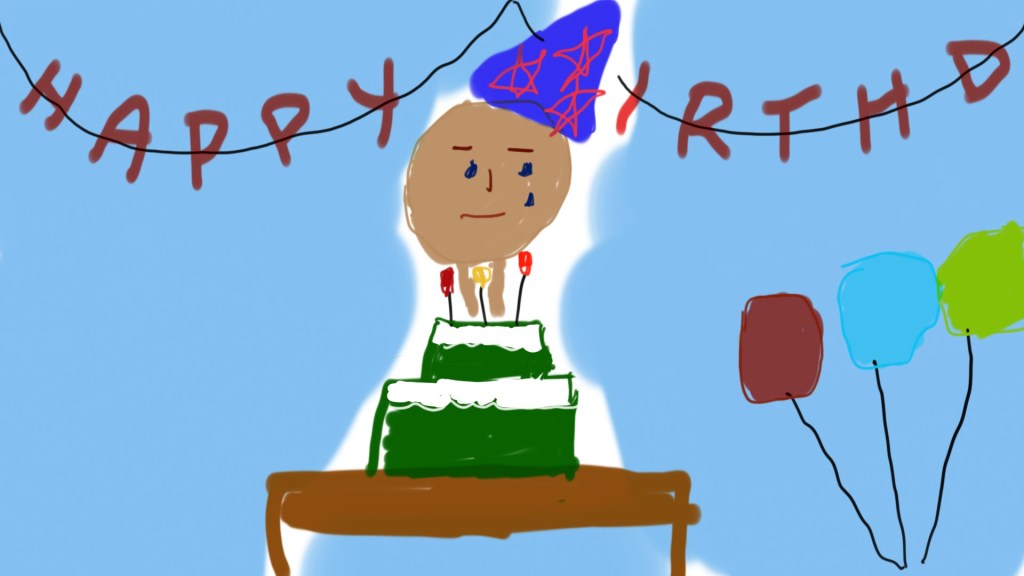
On my birthday, I cried as if my heart was broken.
Now, I know what you might be thinking. That’s not that unusual. You maybe got a little teary on your last birthday too, reflecting on the twelve months of joy and sorrow that had just come to a close. Birthdays are an odd thing, really, because if you’ve had a great past year, you’re probably a little sad that it’s over. And if you’ve had a terrible past year, you can’t be all that chuffed to roll right into the next one.
But this wasn’t that. For one thing, I was only five years old. Way too young for my first existential crisis, and I hadn’t lived enough days gone by to be nostalgic about them. For another thing, I wasn’t crying the gentle tears of retrospection. I was crying because of a deep, specific, and as yet unprovoked anguish.
The waterworks began right as we were sitting down for cake. I remember the cake was in the shape of a train that year. My mother had labored over it, determined to overcome her natural lack of artistic ability. I guess by the time I was five, I was already bored by cake in its traditional form. Cake for cake’s sake was simply not enough for such a momentous occasion. I don’t recall ever being particularly fond of trains, but the one and only thing I was particularly fond of, our English Labrador, Sherlock, was evidently too aesthetically complex to be translated onto pastry.
The cake bore, despite my mother’s best efforts, only the barest resemblance to a locomotive. But what she lacked in piping expertise she made up for in creativity and enthusiasm, with a rainbow of bright colors marking each “car” and the candles arranged where the steam would traditionally come out.
I felt a vague uneasiness as I drew in a deep breath, ready for my cue. Then, as the rousing refrain of “happy birthday” drew to a close, I burst violently into tears.
“Honey?” my mother said, alarmed. “What’s wrong?”
I was crying too hard to respond. Nor would I have been able to formulate a coherent explanation even if my mouth hadn’t been filled with snot and saliva. I had no idea what was wrong, only that something horribly was. My heart ached with an overwhelming sorrow, by far the most potent emotion I had yet experienced in my young life.
My mother stood up from the other side of the table and hurried over. She kneeled beside my chair and put her palm on my face, sweeping aside a lock of hair. “Henry, sweetie, what’s wrong? Does something hurt?”
“Y-yes,” I managed to blubber. I turned and buried my head in her shirt, soaking it with bodily fluids immediately. She patted my back anxiously.
“What is it? Did you burn yourself?”
“N-no.”
“Then what?”
“I d-don’t knoooooow!” I wailed miserably. At the age of five, I had yet to get in touch with my emotions in any meaningful way. Diagnosing my own feelings was a foreign concept, and, having been privileged enough to have a consistently happy childhood, I hadn’t experienced many negative emotions at all.
Completely bewildered, my mother picked me up, wrapped me in a bear hug, and sat me on her lap in our favorite rocking chair. She rocked me back and forth soothingly until, after almost half an hour, my tears abated. I gave a last, great sniffle.
“Are you feeling better?” my mother asked.
I considered the question. The sharp pang of sorrow that had so surprised me had not exactly faded, but diffused into a dull ache of depression.
“No,” I said lifelessly.
“What hurts?”
“Nothing.” I reconsidered. “Everything.”
“Did something happen that made you sad?”
“No.”
We rocked back and forth for a minute in silence. She seemed at a loss, as was I.
“Would you like some cake?” she asked finally.
“No.” For all I knew, the cake had somehow prompted my complete emotional breakdown. Perhaps I would never eat cake again. (Although I think I knew even at the time, in the back of my mind, that this prediction would not come true).
The rest of my birthday was miserable, for absolutely no reason at all. My mother was worried and confused, but after assuring herself that there was nothing physically wrong with me, could think of nothing to do but hover. I, still awash in a nameless despair, moped around refusing to partake in any more festivities. The poor train cake went uneaten, and the small stack of wrapped gifts went untouched. I went to bed early, miserable, hoping that by morning my mysterious ailment would disappear.
The new day dawned gray and gloomy, as befitting my emotional state. Overnight, my heartache had diminished somewhat, but I still suffered from a pervading misery. Was this what happened when one turned five, I wondered? Perhaps this omnipresent ennui was simply the price I had to pay for growing up.
I tried to put on a better face for my mother’s sake. When she asked me if I was feeling better this morning, I pasted on a smile and managed to nod. When she offered me a piece of birthday cake for breakfast, I choked it down, although it tasted like ash. When she asked if I wanted to take Sherlock for a walk, as the day was beautiful, I consented. Sherlock had been exceptionally tired of late, however, and today didn’t seem up for any intense physical exertion. When we presented him with his leash, he eyed us balefully, rotated ninety degrees, and flopped determinedly to the floor.
By midday, I was fully resigned to my newly mature, wizened and depressed state. At least school would start soon, I thought bracingly to myself. Then I could at least attribute my misery to some definite cause.
My mother and I tended to eat dinner very early, since we both got hungry in the midafternoon, and saw no reason to wait until a more socially acceptable supper hour. So, like we had yesterday, we sat down to eat at around 4 p.m., dining sumptuously on fish sticks and mashed potatoes.
My mother and I played a game at dinnertime. The game was called “Then suddenly,” and we had been playing it for as long as I could remember. One person would start out with a hypothetical statement. For example:
“We walked into a dark and dangerous cave.”
The other person would continue the story with a statement beginning “Then suddenly,” and attempt to turn the story on its head. Looking back, I realize it was precisely the opposite of the “never say no” improvisation philosophy. But we apparently enjoyed undermining each other’s ideas.
“Then suddenly, we realized the cave was the belly of a beast,” I said in response to my mother’s cave scenario.
“Then suddenly, the monster vomited us into the ocean.”
“Then suddenly, we saw it wasn’t a monster at all.
“Then suddenly, we gave it a hug.”
“Then suddenly, it was Sherlock!”
Sherlock tended to be a recurring character in our made-up adventures. Usually, when he heard his name, he would come running up, excited to hear what crazy antics he had gotten into now (and, probably, excited at the prospect of stealing some dinner table scraps). Today, however, we looked around expectantly, but no Sherlock appeared.
“He’s been tired today,” my mother remarked.
I shrugged lifelessly. I could relate.
“Sherlock!” my mother called. “Do you want a treat?”
This typically prompted Sherlock to break all rules of decorum and physics in his enthusiasm. Today, nothing.
“Hmm.” My mother frowned, then got up from the table to look for him in the other room. There were a few moments of silence while I poked lethargically at my mashed potatoes.
When my mother returned, she was walking slowly. “Henry, honey,” she said, but didn’t follow up this introduction with any further remarks.
After a moment, I glanced up at her and found a tear trickling down her cheek.
“What?”
She sniffled and wiped away the tear. “Henry, honey,” she tried again. “Don’t go in the living room just now. There’s been a…Sherlock’s very sick.”
I felt nothing particularly in response to this news. “What is he sick with?”
“Um…” she looked conflicted for a moment, then sat at the table–not at her usual chair, but right next to me. She took my hand. “I’m so sorry, honey, but I think Sherlock passed away.”
I pondered this for a moment. “You mean, he died?”
Another tear leaked out her eye. “Yes.” She pulled me in for a hug. “I’m so sorry, sweetie. He had such a good long life, though.”
I could think of nothing useful to say in response to this, so I just looked at her steadily. She began crying harder, and, remembering her kind ministrations yesterday, I patted her shoulder in case it provided any comfort.
“Do you understand what I’m saying?” she asked me, taken aback by my stoic acceptance of the news. “Sherlock’s gone.”
“Yes.” I did understand what she was saying. I felt fairly miserable, but no more so than I had all day.
She wiped her eyes, blew her nose volcanically on a used Kleenex from her pocket, and peered at me. “Aren’t you sad?”
“Yes.”
She stroked my hair sympathetically. “I am too, sweetie. Sherlock was such a good dog.”
He had been. I remembered my last birthday, when Sherlock had woken me up by jumping on my bed, a small wrapped present attached to his collar. The memory prompted no particular emotion, even as I realized that I would never again be treated to a slobbery kiss as I started my day.
After crying for a few more minutes, my mother went into the kitchen to call emergency veterinary services. Disobeying her earlier command, I walked into the living room.
Sherlock was lying on the rug in front of the fireplace. Our fireplace had been broken for as long as I could remember, but some primitive urge in Sherlock’s DNA prompted him to stretch out in front of it anyway, relaxing into imaginary warmth. His eyes were closed.
“Sherlock?” I said experimentally. There was no response. When I stroked his back, I found him stiff and cold.
“Henry!” My mother appeared in the doorway, catching me red-handed. She scooped me up and brought me back to the kitchen. “I wish you hadn’t seen that.”
I shrugged. I still felt nothing but vague unhappiness, even when the emergency vet came in and zipped Sherlock up in a black plastic bag.
“Do you want to say goodbye?” she asked.
“No.”
My mother and I sat on the front stoop as she and Sherlock drove away. “Are you okay?” she asked, stroking my hand. “Tell me how you’re feeling.”
“Okay.”
“You know, sometimes things take a while to sink in,” she told me. “Sometimes you don’t really realize how sad you are until later.”
If anything, I was only feeling less and less sad. I had a strong case of the blues, but it was fading perceptibly. My mother, though, was heartbroken–as sad as I had been yesterday when I blew out my candles.
Suffice it to say, my fifth birthday did not go down in the books as one of my best. It was the first time I got an inkling, though, of my strange relationship with chronology. The strong emotions I should have experienced upon learning of the death of my beloved pet manifested, seemingly without cause, long before I heard the news.
As I grew up and the emotional range of my experiences broadened, I noticed this persistent inconsistency. Twenty-four hours before I made my first friend in kindergarten, I felt an unexpected surge of happiness. Twenty-four hours before I was picked last for the playground kickball team, I felt an unexpected surge of embarrassment. When those events actually occurred, I tried to feel what I knew were the appropriate emotions, but was unable to muster them. Instead, my feelings had already moved on to whatever the next day would bring.
Once I figured out the pattern, I confided in my mother. She was understandably alarmed, and took me to various medical professionals to undergo a bewildering array of tests and scans. They revealed nothing unusual.
“Growing pains,” the doctors would usually say by way of explanation. “Emotions go a little haywire as kids grow up.”
But these weren’t hormonal mood swings. This was a temporal displacement. This was fortune-telling of the most useless kind, since I never had any way of knowing what future event was prompting my perceived emotion. My mother was concerned and sympathetic, but ultimately could do nothing to help. At least around her, I didn’t have to pretend to be normal. To the rest of the world, I struggled to act like I was experiencing the correct emotions at the appropriate times. When we had a pizza party, my classmates would look at me quizzically if I didn’t whoop along with them. When a pop quiz was announced, I was expected to produce an authentic groan of dismay.
Another consequence of my bizarre condition was that I was unable to understand causal relationships in the way my peers did. Specific events were linked to specific emotions, but since the two were separated to such a substantial degree in my mind, I struggled to associate them instinctually. I didn’t automatically seek out pleasurable activities or avoid painful ones, since I had already experienced the emotional reward or punishment.
My condition was, in all likelihood, a matter of earth-shattering import. Had scientists been aware of it (and believed it to be true), I would probably have been the subject of innumerable experiments. But after that first set of doctors proved unhelpful, my mother and I simply adapted to our circumstances as best we could. It was a strange life, but it was the only one I had ever known.
And so, up I grew. I survived kindergarten, then elementary school, then middle and high school. I even made a few friends, although I never confided in them the truth about my Future Feelings, as I began to think of them. I did my best to maintain an even emotional state at all times, avoiding any activities that would cause either positive or negative bursts of feeling. If tomorrow felt exactly like today, I reasoned, I wouldn’t notice the disconnect so strongly. I went to college and majored in the most boring thing I could think of–managerial accounting–and then got a boring job as a managerial accountant that involved doing the exact same thing, over and over again, day after day.
Of course, the big things–the unavoidable ones–still hit me, but I learned how useless it was to try to proactively respond to what the Future Feelings portended. Twenty-four hours before a scheduled meeting with my manager at work, I felt a wave of dismay. Convinced I was going to be fired, I spent the whole day ingratiating myself to my boss, staying late and filing invoices at a speed that can only be described as hazardous. The next day, I found out that my job was perfectly secure, but my friend and coworker was being let go.
On rare occasions, I attempted to game the system. Once, a friend asked me unexpectedly to accompany her on an impromptu trip to Vegas the next day. She was supposed to go with her boyfriend, but he had gotten sick and she didn’t want the tickets to go to waste (that relationship didn’t last long). My initial instinct was to say no, but my Future Feelings were ones of boredom and disappointment. Throwing caution to the winds, I agreed to join her–and then spent the next day trapped in an airport for ten hours as flight after flight was delayed. My emotions, it seemed, were always one step ahead.
It was only my emotional states that were displaced–physical sensations still hit me synchronously with the events provoking them. This, as you might imagine, made for some odd experiences. When I fell and broke my arm my senior year of high school, I felt the shock and dismay twenty-four hours earlier, as usual, but felt the physical pain right on schedule. When I ate sweets, I tasted the sugar as it was passing my lips, but experienced the happiness that came with eating something delicious the day before. As a result, one of the unexpected advantages of my condition was an unusually healthy lifestyle, as the instant gratification of unhealthy habits was not available to me.
I became an excellent actor, navigating my way through every situation convincing the people I was with that I felt alongside them. When I wanted to make some extra money, I even picked up a few acting gigs on the side. I was uniquely well-suited to the profession, since I would experience an overwhelming swell of nerves and stage fright well before the performance, and then be perfectly composed by the time the curtain rose. Still, I disliked the intense emotional flux, and was largely content to stay at my boring office job.
The only other person besides my mother and those few early doctors that I ever told about my condition was my neighbor, Ainsley, and it wasn’t exactly by choice. When I moved in, freshly graduated from college, and ran into her on the stairwell, I remember thinking (not unkindly–just matter-of-factly), that she wouldn’t be my neighbor for long. She was the oldest person I had ever met, and stood so hunched-over that she looked like a parenthesis. She moved at the approximate pace of a fossilized snail, but made up for it by speaking faster than most human beings could easily comprehend. She barked out all her sentences with an unnerving ferocity which at first made me think she disliked me, until I realized she spoke the same way to everyone.
During our brief introductory conversation, I explained that I was a managerial accountant working at one of the large downtown firms.
“Hmm,” she had sniffed. “You find that interesting, do you?”
I was taken aback. “Interesting enough.”
“Well, better you than me, I suppose.”
“What did you used to do?” I asked, recognizing the cause of my vague irritation the day before.
“I was a talent agent,” she snapped, as if the question had caused her personal offense. “It was marvelous. I consider Clint Eastwood a personal friend.”
I doubted that very much, but plastered on a fake smile, told her it was nice to meet her, and disappeared into my apartment. Less than a week later, she had rapped commandingly on my door.
“Why did you say you were just an accountant?” she accused me as soon as I opened the door. “Jenkins”–our landlord–”told me you met him doing a play.”
I had, in fact, met Jenkins doing a regional Shakespeare in the Park gig the summer after my senior year, in an attempt to pay off some of my debilitating debt. I had played Romeo and Jenkins had been the lighting designer. At the cast party, he had mentioned he owned a small apartment building downtown, and I couldn’t pass up the very reasonable rent and very good lighting of his vacant unit.
“It’s just something I do for fun.”
“He says you’re quite good.” Ainsley said this suspiciously, as if she couldn’t imagine a world in which Jenkins’s assessment could be correct.
“He only said that because I knew how to follow a spotlight.”
“Invite me to your next performance,” she demanded. “I’ll be the judge.”
I had no acting prospects on the horizon, or any particular desire to obtain any, so I agreed readily. Ainsley gave me another suspicious look and disappeared back into her own apartment.
Our next encounter was an impromptu lunch invitation. She slid a note under my door one Saturday morning informing me that I was expected for lunch at her apartment at one o’clock that same day. The tone of the invitation brokered no argument.
Unsure what to wear to lunch with a very old talent agent, I put on a tie. I knocked on the door at five minutes after one, and Ainsley opened the door wearing sweatpants and a t-shirt, and was already irritated.
“You’re late,” she barked.
I was under the impression one should always be five minutes late to someone’s house, in case they needed to complete any last-minute hosting preparation. Ainsley, apparently, felt differently.
“Sorry,” I said. “But I brought eclairs.”
I handed her a small box of chocolate cakes I had purchased from the bakery next door. Ainsley pursed her lips but accepted them.
“Come in, come in,” she said, opening the door wider to reveal an immaculate apartment that looked like it had teleported straight out of the 1920s. I wasn’t precisely sure what brocade, in fact, was, but I got an overwhelming impression that the apartment was full of it.
“I’m not much of a cook,” Ainsley informed me unapologetically. She pointed me to the kitchen table, which was full of takeout sushi containers. “I hope you like sushi.”
We sat down and began to eat. I undoubtedly would have felt very awkward if I hadn’t already felt it the day before, but I was able to eat my California rolls with perfect complacency.
“You seem like a very odd person,” she told me after a pause. “There’s something very fake about you.”
I remembered feeling surprised the day before. “I really don’t know what you mean.”
“I was a very good agent, son,” she said. “I can spot a pretender a mile away.”
She said no more about it during that lunch. Instead, she quizzed me on my previous acting jobs, and reminisced at great length about her days working in a mile-high skyscraper in New York City, fending off (she made it sound like) hundreds if not thousands of desperate wannabe actors every day, sometimes with her bare hands. I did what I always did, which was to feign emotional engagement in what she was saying. At one point, though, she gave me a shrewd look and said: “You don’t have to pretend to be interested for my sake.”
The thing was, I remembered being interested yesterday, and I felt bad that she thought I was bored (although, at the moment, I was). “I’m interested,” I told her. She seemed unconvinced, but continued her story without compunction.
Later that night, I wondered why she seemed so much more aware of my emotional disconnect than the rest of the world. I decided the best thing would be to avoid her, but this proved more difficult to accomplish than I imagined. She had evidently taken an unfortunate interest in me, and continued to invite me over repeatedly, knocking on my door for minutes at a time if she (correctly) suspected I was home and just not answering.
And I did, in my unique way, enjoy spending time with her. She had endless bizarre and unbelievable stories about old Hollywood, and though she was strangely perceptive about my inauthentic reactions, they didn’t seem to offend her. She would invite me to obscenely expensive restaurants and just wave a hand irritably when I offered to pay my own way. This was partly out of generosity, but partly because she seemed to know every restaurant owner in town worth their salt, and usually got our meals free.
“What’s your favorite food?” she asked me one day, unprompted.
“Pizza,” I said, my go-to answer. I didn’t really have a “favorite” food, since my emotional attachments to them were so jumbled, but no one had ever batted an eye when I said pizza. Accordingly, the next weekend, Ainsley took me to a breathtakingly ritzy “authentic Neapolitan” pizza restaurant, and scrutinized my reaction closely as I took my first bite.
“Mm,” I said appreciatively, and she snorted.
“Honestly, I don’t know why Jenkins said you were a good actor. I wouldn’t have taken you on as my client.”
“Well, I’m no Clint Eastwood.”
“Honey,” she said loftily. “Clint Eastwood was no Clint Eastwood until I got a hold of him.”
Which led her on an extended tangent about the time she and Clint Eastwood had found themselves in an elevator with the president of Warner Brothers, and had tried to sell him on a movie idea Clint had long been mulling over–a literal elevator pitch–and I thought she had dropped the subject of my poor acting. As we got back to our apartment building, though, she said:
“You can either tell me what your deal is or I can figure it out myself–it’s your decision.”
I chuckled noncommittally and escaped into my apartment.
“I think my neighbor’s onto me,” I told my mother on the phone later that night. “I don’t know how, but she can just tell something’s off.”
“Why don’t you just tell her?” my mother suggested. “What’s the harm? And, it might be nice to have a friend in the know.”
I decided she was right. After all, friendship with Ainsley came with certain perks (excellent free food primary among them), and I feared she would get sick of me if she couldn’t figure out what my “deal” was. And, sharp as she was, I had trouble believing she could possibly guess such an unlikely truth. So, I surprised her by inviting her over for lunch the next weekend–the first time I initiated such socialization.
“I’m not much of a cook either,” I warned her.
“That’s unfortunate, as I’m a very picky eater.”
All things considered, I found it safest to get takeout Chinese, which was ready on the table precisely by the appointed time. Ainsley was never late.
“So?” she got down to business, snapping open a pair of chopsticks and digging in briskly. “Are you going to tell me your big secret?”
“Yes,” I said calmly. I had experienced a fairly intense bout of nerves the day before, but of course now felt totally fine. “I have a strange condition where I experience every emotion twenty-four hours before the event that provokes it.”
Ainsley looked at me thoughtfully, or as thoughtfully as she could while shoveling fried rice ungracefully into her mouth.
“That’s a new one for me,” she acknowledged reluctantly. “So, how does it work?”
I gave her a brief history of my pathetic superpower, beginning with Sherlock’s tragic passing and explaining my present strategy of avoiding all strong emotions.
“That’s silly,” she said bluntly. “You don’t want to be happy, just because it’s at the wrong time?”
“It’s disorienting.”
She rolled her eyes. “That’s life, kiddo. Feelings are always disorienting.”
All things considered, she took the news very much in stride. I supposed that, at her age, nothing could surprise her.
To my surprise, though, it really did make a difference having a friend to confide in. I was able to stop pretending around Ainsley, and she was much better at predicting what my Future Feelings foretold than I was. Once, for example, I was puzzled by a sudden combination of feelings: embarrassment, sadness, and a little bit of pride, all at once.
“Am I going to get, like, fifth place in a beauty contest or something?” I wondered to her.
She pursed her lips. “Where are you going tomorrow?”
“Work, and then probably the gym.”
“The gym around the corner?”
“Yeah.”
“The gym with that hot receptionist?”
“Um…I guess?”
“She’ll ask you out,” Ainsley predicted with supreme confidence.
“No way.”
“Wait and see.”
I waited, and in fact, the very next day, the receptionist gave me a shy smile as I checked in and slid her phone number across the counter. I knew I could never call her. My condition was much too strange to allow for true emotional intimacy.
Ainsley knocked on my door later that night. “Was I right?” she called through the closed door.
“Go away,” I yelled, and she cackled and departed.
After a few more uncannily accurate predictions, I asked her how she so often guessed right. “I’ve got a good ear for story,” she shrugged.
Unfortunately, the day I most needed her help, even a good ear for story couldn’t save me.
That was the day I felt nothing at all.
It was very early in the morning. I felt such intense dread that I actually woke up from the pain of it. I lay there in the dark, bewildered. Was my mother going to die? Was a nuclear bomb going to fall on the city? What could possibly inspire this level of misery? I had had a fairly intense last twenty-four hours, emotionally: alternating bouts of fear, misery, and happiness that I wasn’t sure what to make of.
And then, like a lightswitch flipping off, all my emotions just…stopped. I felt nothing at all, not even a hollow emptiness. It was impossible to describe the sensation, as even when we’re bored or asleep, we’re always feeling something.
But my emotional life had simply ended. Which meant, I understood immediately, that my physical life was soon to follow.
The good news was, I (obviously) didn’t panic. I couldn’t. Instead, I considered the situation impassively. I had, apparently, twenty-four hours to live.
Logically, I was resigned to my fate pretty immediately. I had never had any luck trying to prevent the future (even though, I acknowledged to myself, I had never known with quite so much certainty what the future would hold). But I had no idea how I would die–whether I would get hit by a bus, or have a heart attack, or get squashed by a falling anvil. There were so many ways to die that even if I locked myself in my room for the next twenty-four hours, I wouldn’t be safe.
I tried hard to remember, in more specific detail, what the my emotions the past twenty-four hours had been. Unfortunately, I had been asleep for some of them. And there was nothing I could remember from my waking hours that clued me into the details of my imminent demise. How did I spend my last day on Earth? Did I spend it with my friends and family? Did I pull a Groundhog Day and go on some irresponsible spree?
It seemed I’d have to live on and find out.
I looked at the clock. It was three in the morning. Oh well. A dying man surely had the right to be rude.
I knocked on Ainsley’s door for five whole minutes before she finally yanked it open with the wrath of an avenging god.
“This’d better be good.”
“I have one day left to live.”
“You’ll have a lot less than that if you don’t let me go back to bed.”
I didn’t feel amused, obviously, since I didn’t feel anything. “I’ve stopped feeling.”
She squinted up at me. She was wearing an old-fashioned floral-print nightgown with lace around the edges. “Stopped feeling anything?”
“Right.”
She looked at me for a moment longer, then heaved an irritated sigh and swung the door open. “You’d better come in.”
Once we were seated in her fat chintz living room chairs, I explained again the bizarre cessation of sensation. “I can’t think of anything else it would be other than my death,” I said neutrally.
She made a face. “Don’t say that. Maybe you go on heavy medication or something.”
“But I don’t feel foggy. I just don’t feel.”
She was distraught, which in Ainsley’s case manifested as anger. “Fine then. If you’re so insistent you’re going to die, what are we going to do about it?”
I shrugged. I felt, obviously, no particular sense of urgency.
“There must be something. Surely even you can manage to stay alive for one measly day if we both put our minds to it.”
“Evidently not.”
She glared at me, but I saw the ghost of a tear at the corner of her eye.
“You’re crying.”
“So what if I am?” she snapped. “Just because you don’t have feelings anymore doesn’t mean I’ve lost the right to mine.”
Then she stood up briskly. “Stay here. I’ll be right back.”
“Where are you–” I started to ask, but the door slammed shut behind her before I could finish the question.
I have absolutely no idea where she got it all at five o’clock in the morning, but she returned twenty minutes later carrying a massive bag of survival supplies. There were bandages, Epi-pens, a bottle of disgusting-looking fluid designed to make you immediately upchuck anything you recently ingested, and even a bulletproof vest.
“Better safe than sorry,” she said firmly, and proceeded to foist all the items upon me until I looked like a cross between Batman and an overprepared nursing student. She was seriously considering duck-taping pillows to my back and chest before I drew the line.
“I think that’s probably good.” I had no belief that any of our safety measures would prevent my death, but if she needed them to make herself feel better, I could go along with it.
When Ainsley ran out of things to fuss over, she sat down and clapped her hands together.
“Right. Well, I think we’ve done all we can. Now, obviously, you’ll be staying in here the rest of the day.”
“Ainsley…”
“And you’ll want to call your mother, of course, just in case…”
“I’m not sure I–”
“I have an old paramedic friend, I’ll get him on standby.”
“Ainsley, stop.”
She looked irritated, but paused.
“Let’s go do something.”
She gave me a dumbfounded look. “Go do something?”
“Yeah. Let’s go out to eat, or go, I don’t know, skydive or something.”
“Have you lost your mind? That could quite literally kill you.”
I shrugged. “I’ve got a rare opportunity here. I’m facing my imminent death and I couldn’t care less. Now let’s go party.”
There were many things I had always vaguely wanted to do, and Ainsley and I managed to hit a good many of them. We found a dingy twenty-four hour diner, and I finally participated in one of those “eat as many pancakes as you can for free, and once you make yourself sick you get your picture on the wall” challenges (35 pancakes–the heroic final effort of a dying man). We broke onto the roof of the tallest building in the city–or, I broke onto the roof while Ainsley stood guard outside and snapped at me to hurry up. I closed my bank account, got all my money out in cash, and doled it out to every homeless person I saw. I got the number of a pretty girl on the street and told her I’d call her tomorrow before I remembered that, of course, I wouldn’t.
None of it brought me joy. Obviously. It was hedonism for pure hedonism’s sake. But I did it all anyway.
It was extremely weird to not be able to feel. I was intellectually engaged with what I was doing, I could think about it, but I was completely numb to any kind of emotion. I was neither panicked nor heartbroken, not nostalgic nor curious, not bored nor interested. Simply there.
“Maybe this is what people mean when they talk about being fully present in the moment,” I mused to Ainsley. “No feelings to distract me.”
“Henry,” Ainsley said, almost softly. “I think feelings are what make moments special.”
I knew she felt deeply sorry for me, and I wished I could make her as blase about it as I was. I tried cracking jokes, lightening her mood, but she seemed determined to be upset. It was strange how quickly I lost all empathy for other people’s feelings after I lost my own. I couldn’t understand her sadness and thought, intellectually, it would make much more sense for her to shake it off so she could enjoy our last day together.
The real crisis of conscience, if it could be called that without any feelings of guilt associated with it, was whether or not I should call my mother. I knew she would want me to. But I also knew it wouldn’t bring me any catharsis, or anything at all, and would only make her sad and concerned. Ainsley thought I was making a terrible mistake, and went so far as to snatch my phone from me and dial the number. But she didn’t actually initiate the call, and I put my phone back in my pocket.
“Why not let her enjoy the day?” I said, and Ainsley harrumphed.
Once we had exhausted all pleasure-seeking activities I could think of, we got on the bus and rode it around and around the city, staring out at the sidewalks bustling with pedestrians, all with tomorrows ahead of them.
“What’s your best memory?” Ainsley asked suddenly, after we had been sitting in silence for several minutes.
I considered the question. “You’ll think it’s stupid.”
“Probably,” Ainsley acknowledged readily.
I told the story–such as it was–anyway. “It was three or four years ago–pretty soon after I moved here, actually. I woke up, and I made breakfast, and I went to work. And then I came back, and I was supposed to go to my friend’s birthday dinner, but he got sick and canceled. So I stayed home and read an entire book, start to finish. And I went to bed by nine p.m.”
Ainsley stared at me after I finished. “That’s it?” she asked finally. “I’m waiting for you to tell me you won the lottery.”
“Nope. That’s all.”
“That’s pretty pathetic.”
I smiled. “Not to me. For whatever reason, I felt almost exactly normal that day. I was annoyed when I woke up, and then I was bored at work, and then I was happy while I was reading my book. There was even a moment when the main character died and I felt sad. Like, actually sad.”
Ainsley pursed her lips, clearly not convinced. “Well, it was probably just because you had a similar day the next day.”
“Yeah, I know, and it was. But still. For that day I almost felt in control.”
“You know,” Ainsley said, “I think you overestimate how much normal people feel in control. Most of us are hormonal messes, entirely at the mercy of our brain chemistry.”
“Except for you, of course.”
“Of course,” she said tartly.
“Yeah. But when you feel bad, you can do something that makes yourself feel better. I can’t do that. But that day, it felt like I could, so that’s my favorite memory.”
“My favorite memory was attending the Oscars,” Ainsley said matter-of-factly, and I laughed.
“Well, to each their own.”
Time flows by in huge dollops your last day on Earth. Before I knew it, we had wasted so much time that it had gotten dark. We went back to Ainsley’s, ordered massive amounts of takeout, and sat at her dining room table eating in silence. Finally, I thought it would be unfair to subject her to any more of this.
“I’m going to go,” I announced, standing up.
She looked at me in alarm. “Don’t be silly.”
“No, really. Thanks for today. It was great.”
“Don’t you dare leave.” She stood up. “I might not see you again.”
I leaned forward and kissed her wrinkled cheek. “Bye, Ainsley. You’ve been the best friend.”
“Henry!” she called, but didn’t follow me as I walked out, closing the door behind me.
I went back to my place, locked the door, and texted my mother a lighthearted, “Love you!” She was probably already asleep, and didn’t reply.
Now, I’m sitting at my desk. My apartment is dark. It seems silly to waste any more electricity, or maybe I have a bit of a romantic streak after all, because I am writing this by candlelight, longhand. My handwriting is horrible. I wonder if anyone will be able to decipher this when I’m gone.
If anyone can read it, they’ll probably be confused and surprised by my condition. Or they’ll think this is just a last, odd practical joke. That’s okay. Maybe I’ll even try to hide this paper before I go. I don’t want anyone to think it’s a suicide note.
If I could feel, I think I’d be pretty at peace. I’ve had a good life. Weird, but good. I’ve had family and friends who truly cared about me. And I experienced my fair share of happiness, in my own way. Who could ask for anything more?
I don’t know about what Ainsley said, that emotions are what make moments meaningful. I hope that’s not true. If it is, well, I guess my death is meaningless.
I’m not sure what else to do. I still have a few hours. Maybe I’ll try to sleep.
It worked. I was pretty tired. It’s been a long day. I don’t think I dreamt of anything.
Just a few minutes left. I wonder if it’ll hurt.
Thirty more seconds.
I’m getting a little nervous.
 Welp!
Welp! 
Leave a comment