
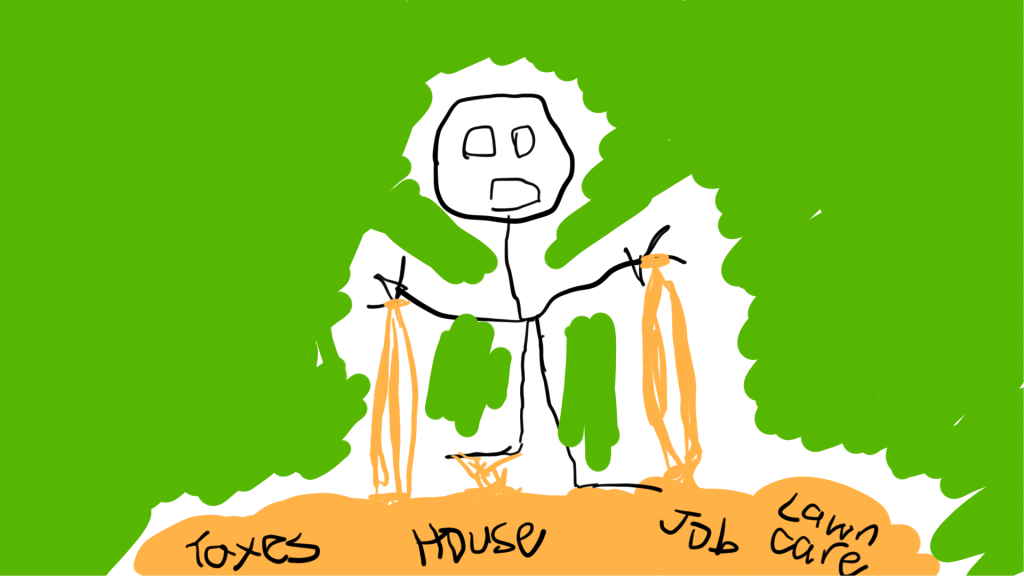
There is an amazing middle grade fiction book called Wednesday Wars. It is sorely underread. It is hilarious and heartwarming and can be enjoyed at any age–in fact, maybe stop reading this blog post and read Wednesday Wars instead.
Many quotes from that book are memorable, but there’s a very random one that I think of a lot. The main character, a teenage boy, is responsible for mowing the lawn during the summer. On the last day before cold weather hits, he mows the lawn. Then his dad re-mows it immediately afterward, saying something like “It’s going to look like this all winter, so it’d better look nice.”
I think about this quote all the time. The ability to A) recognize when something is going to last a long time, and B) optimize that thing so you are left with the best possible iteration of it for that length of time is a huge and necessary asset for adulthood.
I have found adjusting to adulthood a lot harder than I thought it would be, and I’ve been thinking a lot recently about why that is. I believe I am relatively intelligent, mature, and well-adjusted (minus my unhealthy predilection for cinnamon toast crunch). I would have never predicted that I’d be the type to undergo a quarter life crisis or be overwhelmed by the responsibilities of adult life.
So what is it, precisely, that I am struggling with–and why are so many of my generation experiencing similar struggles, at a higher rate than in previous decades? I believe a major and often overlooked challenge of adult life is what I am calling its stickiness.
What do I mean by stickiness?
At first, I was going to call it “boring.” Adult life is boring. But that’s not exactly what I mean–it is in many ways a joyous thing to be bored during your day-to-day life, since it means you are not actively panicking or stressed out. And the word “boring” has a very negative connotation that I don’t want to inflict on the entirety of adulthood.
But adulthood, or at least the way we’ve structured adulthood in America in the 21st century, is extremely repetitive. It’s cyclical. It’s sticky: you get stuck doing essentially the same thing in essentially the same way, for the entirety of your life.
All of the major aspects of our lives trend, in adulthood, toward repetition and stagnation. The traditional arbiter of success in a career is longevity. The longer you stay at a place, the more money you earn, and the more social approval you receive. When Americans think of the stable, traditional, respectable adult professional life, they think of that dude who’s woken up at 6 every morning, fixes his normal cup of black coffee, commutes–rain or snow–into the same office he’s commuted to every day for the last thirty years, works till 5 with the same people he’s always worked with, and goes home only to do it all the exact same way the next day.
It’s the same with relationships. In our society, a long-lasting and stable marriage is viewed as the pinnacle of what you can achieve in terms of romantic relationships. You get tax breaks for being married–you literally receive a financial incentive to wake up next to the same person every single morning for the rest of your life.
The same principle applies for where you live. In our society it is much more financially advantageous, in the long run, to buy a home rather than rent. Government bureaucracy makes it unbelievably annoying to move–you have to change your official address in twelve million different places, reroute your mail, pay a different state or city income tax, change your driver’s license and car registration…it feels like the whole world is telling adults to pick a city when they’re 21, buy a house there, and live in it for the rest of their lives. Sure, you can move, but it’s so inconvenient and arduous that you are going against the grain of society rather than with it to make that choice.
So I mean “stickiness” in the sense of “something you are likely to get stuck in.” Adulthood is cyclical, repetitive, and we’ve structured our society to make it difficult to get unstuck from any of those cycles.
One of my very earliest memories is throwing an epic temper tantrum when I internalized the fact that I was going to have to swallow every few minutes FOR THE REST OF MY LIFE. I viscerally remember my little toddler brain reeling at this fact. Are you freaking for real? I remember thinking, or the “goo goo gah gah” translation of that sentiment. This isn’t a particularly pleasant task. I’m going to have to do it ALL THE TIME until the DAY I DIE?
Well guess what–all of adulthood is like that. I am going to have to pay my taxes at the same time every single year until the day I die. I am going to have to go into work five days a week, every week of the year, until the day I retire–or die, which given the current trajectory of the world may come first. I am going to have to get the oil changed in my car every 10,000 miles (10,000 miles? Is that right? If that’s wrong someone please tell me because right now I just wait till the scary light turns on) until this country builds sufficient public transportation so I can–lol, I mean, until the day I die.
I turned 27 last month, and you’d think I would have adjusted to the absolute hamster wheel that is every facet of adulthood, but I simply have not yet. I am constantly surprised and disappointed anew at the obligations from which there is no exit.
It’s the repetition itself that is burdensome
It’s not like all aspects of adulthood are terrible. I don’t even hate getting my oil changed that much. Car mechanic shops excite me. It’s the repetitiveness of it–the stickiness of it–and the knowledge that there is no end date in sight other than my cosmic one.
It makes everything I have to do so much harder, because it doesn’t feel like I am just doing that thing, it feels like I am committing myself to doing that thing forever and ever until death do us part. Adulthood is being married to your set way of living.
Why is this so hard to adjust to?
There are a few reasons that I, and many others of my generation, are finding the transition to adulthood so challenging.
#1: Childhood and teenage years are deliberately non-sticky
Before you graduate college, I would argue that most of your life is structured around change and exploration. Sure, you go to school every day–but each semester or year, your classes change and your teachers change and your classmates change. Gen ed requirements mean that you have to study a pretty wide range of topics and disciplines, so the areas of your brain that you are using and the type of work you are doing change constantly.
You have internships, but internships are beautiful things because you know when they’re going to end before you even begin. It is so, so much easier to deal with the coworkers that annoy you or the assignments you hate when you know there is a finite period in which you’ll have to deal with them, and then that period will be over. If you have ever put in two weeks’ notice at your job, you may have experienced this glorious feeling. Suddenly, everything that used to annoy you no longer feels like a big deal, because you can roll with any punches for two weeks and then you shall be free!
Moreover, there is simply a great deal of social encouragement and affirmation to try new things and explore when you are a child or teenager. There is no stigma to overcome–you are almost expected to switch hobbies and friend groups and identities frequently as you are deciding what kind of person you want to be in adulthood.
But it’s not like some switch magically flips when you turn 21–or at least, it didn’t for me. It’s not like I suddenly realized “yep, I’m totally confident I have found the kind of person I want to be and now I’m ready to be that kind of person every single day until I die.” If we give children and teenagers the grace and space to explore, why do we yank that grace so abruptly away when an arbitrary age of “adulthood” is reached?
#2: My generation is terrible at being bored
Every blog post ends up blaming the internet one way or the other! Thanks to the digital age in which we grew up, and the constant competing demands on our attention from thirty-second nonsense clips on social media, my cohort is awful at being bored. We can’t stand it. The concept of sitting somewhere without pulling out our phones and distracting ourselves is inconceivable.
And yes, that kind of in-the-moment boredom is very different from the existential “I feel stuck” boredom I’ve been talking about–but we happen to be terrible at both kinds. Our incapacity to be in-the-moment bored has led us to all have jumpy nervous systems and constantly compare our lives to others’, making it harder for us to settle into the “I feel stuck” existential boredom.
At some point, (most) adults will commit to the sticky
Our society rewards stable adults who commit to doing a consistent thing and living a consistent way for the rest of their lives. And it’s not just the tax breaks–there are plenty of emotional benefits to stability. I imagine there is something soothing about working the same job every day for thirty years. There must come a sense of “I’ve seen it all and can handle anything.”
So I totally understand the advantages of traditional adulthood, and I know myself well enough to realize I’m not special. I’m not going to, like, join the CIA and live a reckless and exciting and ever-changing life forever. At some point, like most adults do, I will decide to commit to the stickiness. At some point, I will decide my lawn looks the best it’s going to look for the winter and I’ll stop mowing it.
But I fear that many people my age have committed to the sticky too early. Just like the Wednesday Wars dad re-mowed the lawn right after his son did it, it is the right and responsibility of early-stage adults to try enough things that they truly optimize their way of living before they commit to living it for the next several decades.
And I really don’t mean to be judgmental–there is a cost benefit analysis to committing to the sticky, and people can decide that the benefits outweigh the drawbacks at any stage of life–including right after graduation if that’s what’s best for them. I have no issue with that. But I fear that our overwhelming social encouragement of stability/stickiness has led people to hurry into making that commitment before they’ve truly optimized: before they’ve experimented enough to know what things they really can be pleasantly bored doing for the next five decades.
I personally have not yet found my way of life that I can sink into for the rest of it. But with every new thing I try, I believe I get closer, and the benefits of stability are becoming increasingly appealing to me. Those scales haven’t quite tipped yet–but they will, and I can see it coming. Until then, I will just have to contend with some level of shame about not acclimating fully to “successful” adulthood.
Committing to the sticky isn’t inherently good or bad, and there are no inherently right or wrong times to do it. But when I do commit to the sticky, I want to make sure I am setting myself up for the best possible boredom, and that I’m doing it because I’m ready rather than because the world is pressuring me too.
And I’m never buying a house, because mowing the lawn freaking sucks.
 Welp!
Welp! 
Leave a comment